Partner with us for reliable IT support. Contact us now and find out how we can streamline your IT needs!



As Australian firms race to deploy artificial intelligence (AI), many are finding that success depends less on algorithms than on process, governance and culture. Operational discipline – not constant innovation – will determine who gains the lasting advantage.
Across the country, organisations are experimenting with generative and agentic AI, eager to capture its promise. Yet enthusiasm often outpaces readiness. While AI has become the centrepiece of corporate ambition, many have struggled to find the right starting point or to measure success in practical terms.
That gap between ambition and execution is where firms such as systems integrator Brennan see opportunity.
The company argues that AI readiness begins long before any model is trained. It starts with governance, data integrity and culture.
Like transformative technologies before it – from the telephone to the smartphone – AI’s full potential will only become clear over time.
Unlike past shifts, however, its impact is highly bespoke: shaped by each organisation’s data, culture and purpose. That flexibility is both its strength and its challenge.
Brennan advises clients to view AI adoption as a strategic programme rather than a technical rollout. Tight funding conditions have made it harder for CIOs to secure investment without clear business cases, and as AI moves from curiosity to board agenda, technology leaders face growing pressure to show tangible strategies and returns.
Engaging the CFO early is essential, particularly when research from ADAPT, an Australian technology insights and advisory firm, shows that 60 per cent of finance leaders doubt their organisation can build a convincing AI technology use case.
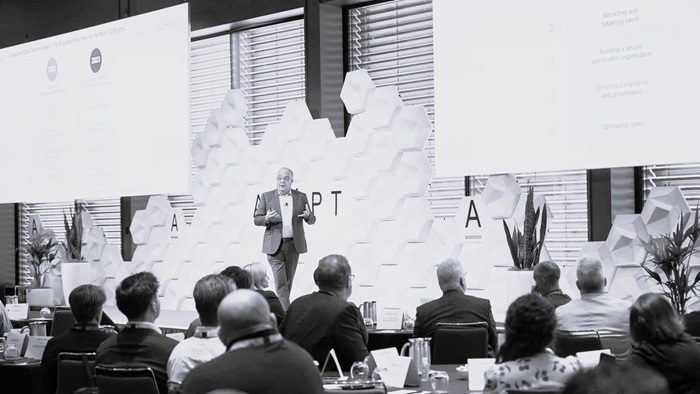
“We don’t try to boil the ocean,” says Nick Sone, Chief Customer Officer at Brennan. “The key is proving value quickly. Bring the right people together – the business stakeholders with the use cases – and run focused workshops to prioritise what truly moves the needle.”
This “micro-innovation” approach helps organisations balance ambition with practicality. By delivering fast, measurable results, it creates the confidence and momentum to expand.
Strong data foundations and process discipline are the bedrock of AI success. In many cases, it’s important to show clients what good data actually looks like: clean metadata, domain-specific libraries and strict access and governance controls.
But process, Sone stresses, matters even more.
“Process is the alpha and the omega. If the process isn’t clear – the starting point, the risks, the standardisation of outcomes – that’s when mistakes happen. With the right structure and checkpoints, you don’t need perfect data to get good results.”
Nick Sone, Chief Customer Officer, Brennan
One Australian utility ombudsman learned this lesson firsthand. Having created chatbots to handle customer complaints across gas, water and electricity services, diffuse knowledge underpinning the service was creating highly dispersed answers, with their chatbot unable to direct customer complaints accurately.
The solution came when Brennan restructured the client’s knowledge base, partitioned content into domain-specific libraries, applied clear metadata and access, and assigned specialised bots to handle specific issues in sequence. Answers became context-aware and consistent, with the AI agent knowing which content to trust, and when to defer to a human, dramatically improving accuracy, reducing escalations, and lifting the customer experience.
As organisations introduce AI into critical systems, trust becomes non-negotiable. Clients are encouraged to integrate governance and compliance from the start rather than retrofit it later.
Testing must also be exhaustive.
“Testing AI outputs can take as long as building the bot itself,” Sone says. “Exhaustive testing ensures that when the underlying engines change, performance remains consistent.”
Data sovereignty is also emerging as a growing priority. As one of Australia’s largest independent systems integrators, the firm champions keeping sensitive information onshore and within clearly defined guardrails. That focus on control and accountability aligns with broader industry sentiment around responsible AI.
Australia is considered one of the more AI-friendly markets globally – keen to innovate but equally serious about governance. That balance between ambition and oversight is seen as critical to building long-term confidence in the technology.
This focus on control and accountability reflects a broader regulatory push for safe and structured AI adoption across Australia.
The Tech Council of Australia says clear, risk-based regulation will be critical to building both trust and investment confidence in AI, arguing that clarity is vital to both trust and investment.
“AI is transforming how businesses operate and these gains aren’t confined to the tech sector; broader AI and tech adoption can deliver significant benefits across the entire economy.”
Damian Kassabgi, Chief Executive, Tech Council
As AI begins to reshape work at every level, meanwhile, technology adoption must be matched by cultural readiness. Training and safe experimentation help staff see AI as an ally, not a threat.
“AI might not take your job, but someone who uses it well might,” Sone says.
Yet despite this reality, fewer than one in four Australian organisations currently have formal AI training in place and just over one in 20 mandate AI training, according to ADAPT. This is a shortfall that risks misuse or underuse of new tools.
All of this will need to change in the coming years.
The organisations that will lead in the age of AI are those that make operational innovation habitual – embedding strategy, governance and culture into every experiment. In the end, success will depend less on speed and more on the discipline required to turn innovation into habit.
This feature originally appeared on the Australian Financial Review, 28 October 2028 (free to read).



Partner with us for reliable IT support. Contact us now and find out how we can streamline your IT needs!