
Partner with us for reliable IT support. Contact us now and find out how we can streamline your IT needs!

A two-speed AI reality is now clear: those experimenting in production, learning quickly, and compounding gains; those still circling governance, tooling and confidence. The good news: genuinely useful applications for AI are increasingly in reach for all. The sobering news: the flywheel effect is real, rewarding teams that lean in thoughtfully, decisively and quickly.
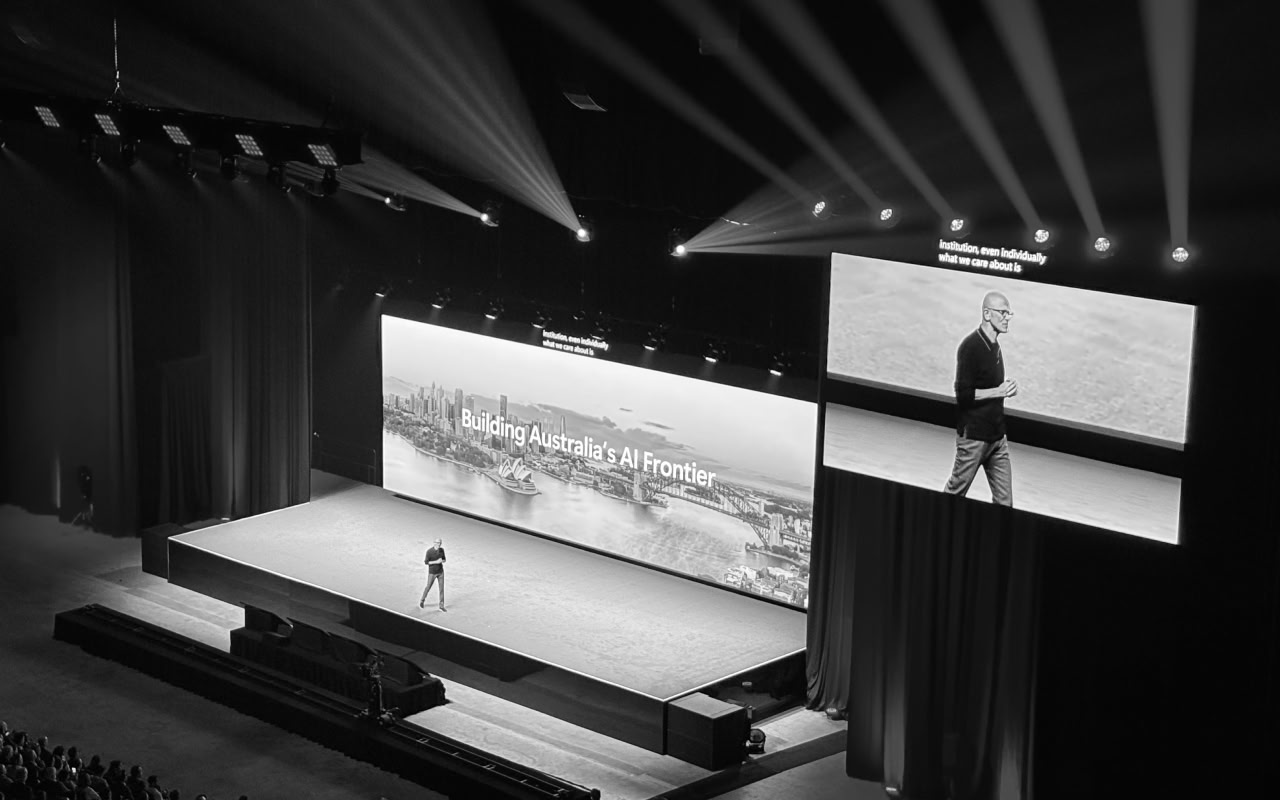
Down in Darling Harbour, as a light breeze riffled yacht sails, the louder sound was the chatter of delegates snaking outside Sydney’s International Convention Centre.
Security lines stretched deep into Darling Harbour with magnetometers working overtime. More than 5,000 people passed through the venue across the day, filling theatres, demo zones and corridors with the sort of energy that only appears at a festival, or when a market senses something important is underway.
Microsoft’s AI Tour did not feel like a speculative technology conference. Not entirely. It felt like a business conference wearing technology clothes.
The central question at the event was no longer whether AI will shape organisations. (Everyone knows it already is.) It’s how quickly organisations can turn its promise into something useful, safe and repeatable. The unsaid question we were all thinking was: how far ahead/behind the curve are we?
Satya Nadella’s keynote covered the big canvas: how AI is reshaping work artefacts (documents, spreadsheets, inboxes), how the platform stack is evolving (models, context, agents, orchestration), and why security and governance need to be built in from the start.
The headline announcements centred on platforms, infrastructure, and enterprise utility:
The message was clear: AI is being positioned not as a side tool but as a new computing layer.
And writ large in his keynote (literally and figuratively), Microsoft’s CEO returned repeatedly to a theme that sat above product launches and platform names.
Intelligence multiplied by trust.
In other words: the more capable the systems become, the more important it is that we can see what they’re doing, control what they can access, and prove what happened after the fact.
From the floor | Emma Clark
“Microsoft’s A$25B commitment in Australia (and the focus on national cyber partnerships) made the direction of travel feel unmistakable: AI adoption is only accelerating. The message that landed for me was that intelligence and trust have to move together – and if we get voice + CRM right, sales and marketing could claw back hours each week while improving pipeline accuracy.”
Emma Clark, Senior Marketing Manager, Brennan
A useful moment came via the Australian context: hearing from Telstra and Westpac’s about what it takes to move beyond pilots. Anthony Miller (Westpac) and Vicki Brady (Telstra) emphasised that AI is ultimately a people change as much as it is a technology change: skills, incentives, culture, and permission to try.
They also reinforced a familiar lesson from past transformations: simplifying foundations matters. Westpac described a journey from dozens of data platforms toward a smaller target footprint, and Telstra spoke to the operational reality of embedding AI across customer engagement, teams, and network operations.
There were also tangible “here’s what it looks like” markers. Telstra referenced launching a generative AI assistant that now handles around 30% of interactions in their web and app journeys without needing a human to step in (with clear guardrails and hand-offs for sensitive cases).
Westpac talked about the challenges, and opportunities, of creating an environment where it’s safe to rethink entrenched ways of working in a heavily regulated industry.
One theme became clearer as the day went on.
Some organisations have already moved far, far beyond experimentation. They are deploying tools, training staff, simplifying estates and learning through use. Others remain in a holding pattern, watching closely but moving cautiously.
From the floor | Steve Anderton
“What stood out for me was the gap between the uninitiated and the advanced. Some organisations are already using AI meaningfully. Others are still treating it as an assistant on the side. The larger operational shifts are not yet widespread.”
Steve Anderton, Head of Customer Solutions, Brennan
That divide is widening quickly. The organisations leaning in are building internal literacy, governance muscle memory and practical instincts that cannot be bought off a shelf later. The experience compounds the advantages.
For us, the day sharpened three practical takeaways.
First: getting “AI-ready” is a bundle of foundations (identity, data protection, lifecycle controls, and safe access to enterprise knowledge) that make faster experimentation possible, not slower.
Second: the organisations seeing momentum are the ones treating AI as a product discipline and an operational opportunity, with measurement, iteration, and change management.
Third: the most valuable use cases are increasingly specific. The winners were tightly scoped agents that remove real toil and make experts better at what they already do.
The Microsoft AI Tour felt like watching the tide come in. It’s said a rising tide lifts all boats. Provided you have a boat. Some organisations are already pushing theirs out into deeper water. Others are still discussing the weather.
In Part 2: we’ll go deeper into the sessions that felt the most “real world”. How Microsoft is applying AI internally as Customer Zero, what a ‘frontier firm’ actually looks like in practice, and the agent patterns (and governance) that turn a demo into something you can run safely at scale.



Partner with us for reliable IT support. Contact us now and find out how we can streamline your IT needs!