
Partner with us for reliable IT support. Contact us now and find out how we can streamline your IT needs!

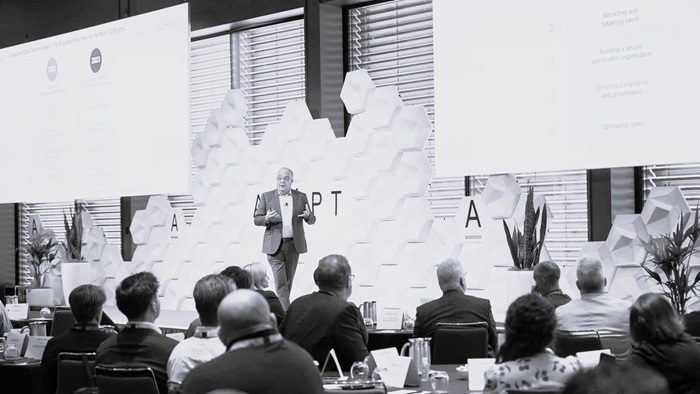
The throughline connecting almost every session at ADAPT CIO Edge Sydney 2026 was clear:
The Agentic AI era is here, and forcing a redesign of operating models, not just technology stacks.
While organisations remain focused on platforms, models and pilots, the real disruption is unfolding elsewhere. Ownership of work is shifting. Risk is becoming continuous rather than episodic. Productivity gains are appearing faster than organisational design can absorb them. And leadership capability is being tested in ways that traditional digital transformation never demanded.
Together, these signals point to a shift in the CIO role from technology leader to operating model-architect.
It is hard to recall a period in modern technology leadership that has felt this dynamic, this volatile.
The way AI – and now Agentic AI – is dominating the organisational, institutional, and public imagination at the same time is remarkable.
For technology leaders, the result is a cognitive overload. It was against this backdrop that 220+ CIOs gathered in Sydney for ADAPT CIO Edge Sydney. Here’s what we learned.
The most grounded articulation of this challenge came from Solly Brown’s ‘CIO’s Agentic AI Playbook’ session.
A large proportion of today’s work is already technically automatable. Yet global research and client engagement suggests only a small fraction of roles will be fully automated. The dominant impact will instead be partial, uneven and deeply disruptive to how individual roles are composed.
This creates a structural tension that many organisations are not yet designed to manage. Rather than AI capabilities, the constraint is the ability of organisations to absorb continuous role re-design, capability shifts and workflow re-composition at scale.
Brown described this as a widening gap between what is technically possible and what organisations are practically able to implement. That gap, he argued, now represents a competitive opportunity for organisations that can adapt their operating structures, governance and leadership behaviours fast enough to close it.
For CIOs, their job is no longer confined to modernising technology environments. It includes active partnership in how the organisation itself changes, how roles evolve, and how work is redistributed between human and digital labour.
In effect, the enterprise is becoming a continuously reconfigurable system. Most organisational design models assume stability between major transformation programs. Agentic AI removes that stability.
One of the clearest operational signals was how often organisations are still capturing AI value at the individual level, rather than at the process or enterprise level.
Most early deployments focussed on personal productivity tools and small proofs of concept. These deliver visible time savings, but that time typically remains unstructured and uncaptured by the organisation.
The distinction that emerged repeatedly was between three stages of maturity:
Only the third produces material enterprise value.
Re-imagining processes removes cycle time, compresses decision latency and accelerates time-to-outcome. It shifts the benefits from cost avoidance to revenue and service impact. That, speakers argued, is the defining difference between incremental AI adoption and an AI-first operating model.
Yet very few organisations are operating at that level today. The more sobering implication is that many enterprises may already be experiencing meaningful AI productivity uplifts, while simultaneously failing to improve organisational performance in any measurable way.
A striking consistency across the day was how governance was described.
High-performing organisations were not characterised by lighter controls but by clearer, faster and more scalable governance and shared three common attributes:
These organisations are organised around risk rather than paralysed by it. This becomes particularly important as agentic systems begin to operate across multi-step workflows and increasingly autonomous decision loops.
A consistent, if less explicitly labelled, dimension of governance maturity is data. As agentic systems begin to act across multiple datasets, applications and decisions, weaknesses in data capture, lineage, architecture and security rapidly become operational risks rather than hygiene issues.
Several speakers noted that without strong data governance and security, organisations are placing a ceiling on how autonomous, scalable and trustworthy their AI initiatives can become.
Panel discussions made clear that the centre of gravity of the CIO role is already moving.
Funding conversations are changing. Business leaders are increasingly initiating investment proposals when operational constraints become visible and AI demonstrates new possibilities.
At the same time, CIOs are becoming more deeply embedded in enterprise strategy formation. In current research, 64% report being heavily involved in shaping business strategy, and the highest-performing organisations now derive more than 5% of EBIT directly from AI-enabled initiatives.
This reflects a deeper shift. As agentic systems reshape software dev lifecycles, operational workflows and service models, technology architecture increasingly becomes business architecture.
In practical terms, CIOs are now being asked to design environments capable of supporting very large populations of digital workers, operating in coordinated sequences, with human oversight embedded across every stage of execution.
This is less an extension of traditional IT operations and more a new form of organisational infrastructure.
“The CIO conversation is starting to shift away from platforms to business architecture, value delivery and accountability for how human and digital workers perform together. In tandem with the persistent questions of data strategy, governance, and security, CIOs are increasingly asking, and being asked, how they can redesign their organisations to make AI tools matter.”
Nick Sone, Chief Customer Officer, Brennan
Agentic AI is not primarily testing technical capability.
It is testing whether organisations can redesign how work is owned, risk is governed, value is measured and how leaders develop in environments where increasingly capable digital workers operate alongside human teams.
The redesign, however, is only sustainable if the data foundations are deliberately rebuilt. Data capture, storage architecture, governance and security now form the practical ceiling on how high and far agentic systems can be trusted to work inside core workflows.
For CIOs, refining data strategy today has become a prerequisite for realising AI value tomorrow.
More broadly, the CIOs role is becoming less about delivering platforms and more about shaping how human and digital workers function together inside the enterprise.
It’s a challenge that no longer sits solely within the boundaries of IT.
It now sits at the centre of organisational design itself.



Partner with us for reliable IT support. Contact us now and find out how we can streamline your IT needs!