
Partner with us for reliable IT support. Contact us now and find out how we can streamline your IT needs!

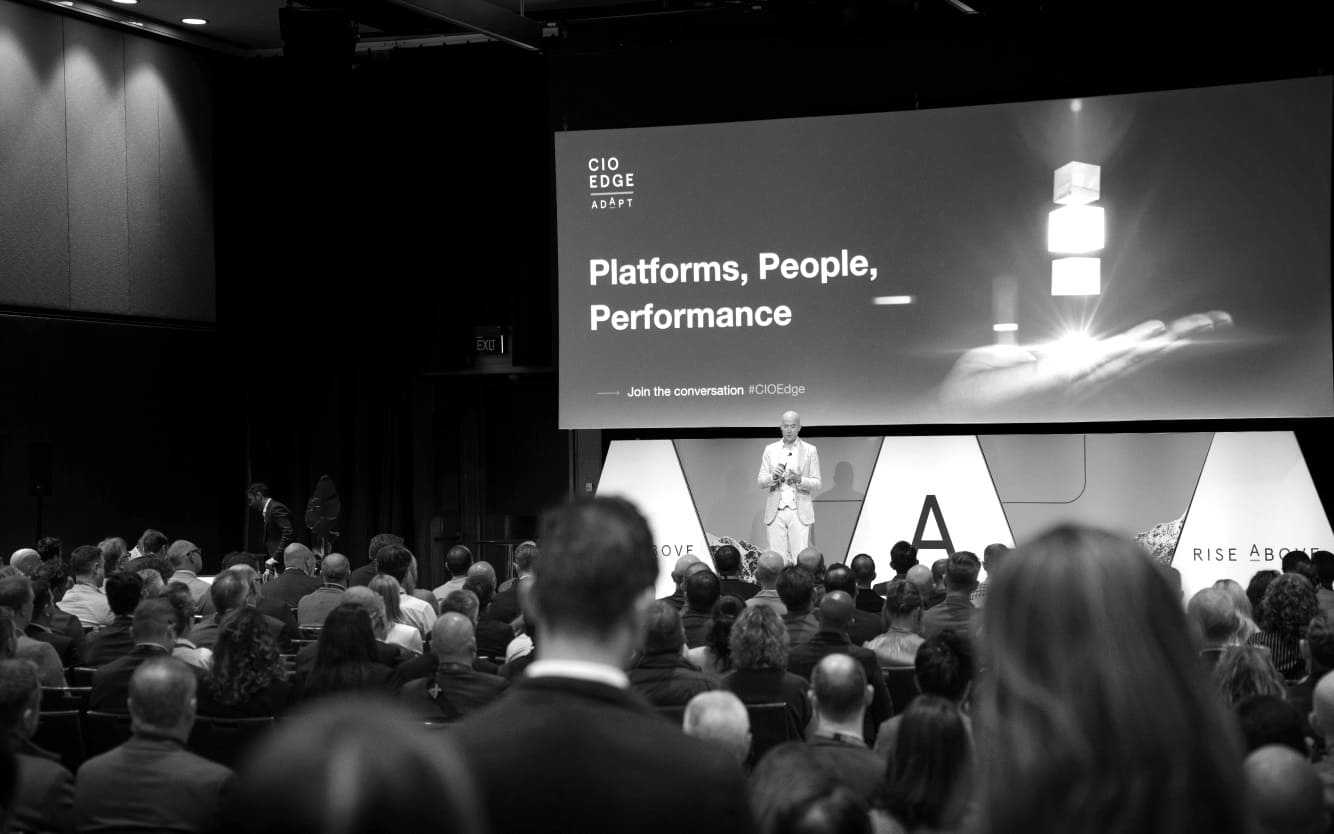
After a forever winter, and with the first buds of spring emerging, ADAPT CIO Edge Sydney 2025 carried a palpable buzz. Inside, more than 180 CIOs and IT leads gathered, representing companies responsible for a third of Australia’s business wealth and prosperity.
The conference theme – Platforms, People, Performance – was deliberately broad. But the through-line was unmistakable: Artificial Intelligence. The tech darling is no longer hogging the limelight. It is the light. But can tech leads handle the heat?
Framed as the most consequential technological development of the past fifty years, with the potential to shape the next fifty (maybe more), there were hints that AI’s newness has been supplanted with a fresh sentiment: apprehension.
For CIOs, AI will define their careers and reputations. For organisations, AI will determine trajectories. Some even suggested there was perhaps a year left to till the soil in preparation for agentic AI or face losing first-mover advantage. The pressure to deliver is rising.
Across sessions, the message was clear: platforms are creaking under the weight of legacy baggage. Around 40% of mission-critical apps still run on legacy infrastructure, and with data duplicated and triplicated across environments, orchestration has become as important as innovation.
The numbers tell their own story. 43% of CDAOs are increasing AI investment, while compute demand is set to surge 23% in FY25 and 26% in FY26, far exceeding earlier forecasts. AI isn’t additive. It’s an accelerant, dragging every workload along with it.
But more compute and more spend won’t automatically deliver outcomes. Sometimes, it takes storytelling.
One of the Big Four banks shared how a core truth, delivered clearly, with a simple metric everyone can grasp, can become the transformation flag everyone rallies around. In their case it was simple: every $1 spent on change currently costs us an additional 70c in complexity. Every initiative was geared to bring that ratio down to 1:1. Their solution was visual clarity – models showing end-to-end architecture, simple metrics everyone could grasp, and a unifying language. Acronyms like BEAD (Build for Change, Evergreen, Automated, Digital to the Core) helped communicate targets beyond the IT function.
And in industries as diverse as lotteries and financial services, consolidation was the rallying cry. One CIO described migrating eight systems down to one, reducing duplication and sharpening performance. Another pointed to in-house platforms, not as a cost but as the core of competitive differentiation.
If platforms were about consolidation, people were about conviction. The question “Who owns AI in the enterprise?” sparked debate. Most CIOs agreed it logically falls to the Chief AI Officer. If only they existed. Such roles are still rare. The reality is CIOs and CDOs are carrying the burden.
But ownership isn’t purely about job titles. It’s about courage and trust. One defence CIO put it starkly: trust is earned in tears, lost in gallons. Deliver once, and confidence grows; falter, and it evaporates.
With AI initiatives, you need to let the string out for experimentation to fly but be ready to reel it back in for control. That balance of risk and reward is becoming central to the CIO role.
The gap, though, is stark. Only 6% of organisations currently mandate AI awareness and training, even as the technology is embedded deeper into workflows. Meanwhile, 76% of CISOs say their organisation is not ready for AI, and 72% of CDAOs report it hasn’t yet met expectations.
The deeper message: AI adoption is as much about winning hearts and minds as it is the technology. Leads spoke of the need for personalised roadmaps for different stakeholder groups, simple visuals to explain sequencing, and the courage to admit when priorities must be reshaped.
As one panellist observed: transformation always involves crocodiles. The key is not pretending they aren’t there but safeguarding your people as you cross the river.
The performance lens brought the sharpest reality check. Despite huge interest and investment, just 4% of CIOs reported AI delivering any meaningful ROI. For many, the expense hasn’t yet yielded the return. But should it?
As one executive argued, no one demands ROI on a mobile phone, even though every employee uses one for work. AI, too, may simply become a baseline cost of doing business.
What CIOs are grappling with is expectation management. Boards and executives are pressing for quick wins; developers and employees are seeking meaningful tools. Bridging that gap requires more than incremental pilots. It requires ambition.
That ambition was on display when the CEO of digital mortgage broker mapped out their journey. From a fintech startup to the acquisition of a high street brand, and now with plans to expand into an end-to-end property ecosystem, their story is one of relentless ‘platformisation’. Their big ambition: become an AI-native company.
And for this company, that means three things:
Execution is already underway. Every after-hours call and web chat is handled by AI. A centre of excellence empowers staff to experiment. And critically, the CEO and CIO share a radically transparent partnership, aligned on governance and planning, speaking with one voice.
It was a case study in performance under pressure – building not just for ROI, but for resilience and growth.
The novelty of AI is yesterday’s news. In its place: a potent mix of pressure, expectation, and an unmissable opportunity. Whether in banking, defence, lotteries, or digital mortgages, the same message rang out: simplification unlocks scale, and people unlock performance.
For many CIOs, the coming year may prove decisive. There’s still time to till the soil before AI becomes commoditised. On with the dig.




Partner with us for reliable IT support. Contact us now and find out how we can streamline your IT needs!