Partner with us for reliable IT support. Contact us now and find out how we can streamline your IT needs!


What breaks first when innovation accelerates? Who owns an AI agent across its life? Build AI, or buy it? Who's accountable when an agent's output touches a real person outside the business?
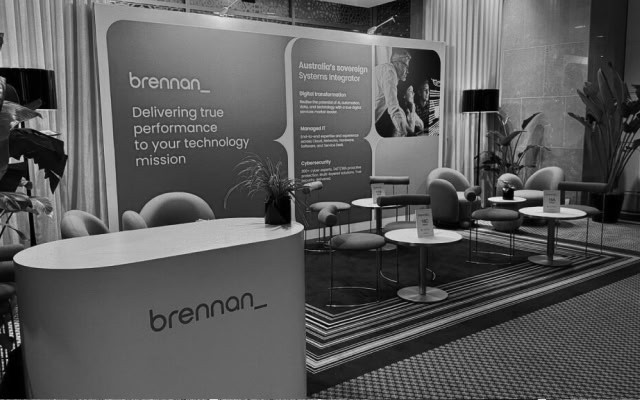
These were the questions posed at the Brennan-hosted ADAPT CIO Edge roundtable. 21 tech leaders – from banking, health, government, retail, insurance, and critical infrastructure – had a lot on their minds. Their question back to the room: what breaks when organisational ambitions, sprinting at the breakneck pace set by AI's capabilities, outrun their own operating model?
What breaks first when you compress delivery time to get an AI project done fast?
The room's answer, in the end, is capacity: the people and processes need to keep pace with intelligence that never tires.
That capacity gap showed up in strange places. One delegate's automation project had saved 100+ person-days on QA testing, only to find the same pressure resurface as a UAT bottleneck instead: "The fix was, ‘How about we throw more humans in the loop?’, which kind of defeats the purpose." For another, the same bottleneck sat with the board. Too many AI initiatives were landing with leadership to review and carefully weigh their value at the pace they were being produced.
One advisor, who's been talking to businesses further along this road, offered a broader observation: Australian firms, who tend to lean conservative, are mostly starting with personal productivity initiatives. Individuals are finding or setting their own pace with the tools (and for some, that pace is blistering) well before their organisation catches up with a genuine, ROI-driven productivity phase. It's best, this advisor said, to think of them as two clocks running at two different speeds.
Brennan's own answer to the same pressure is a purpose-built innovation system, in which sets of agents validate ideas then pre-seed the code, with development sprints shrinking from months down to weeks or even days. The team now running it full time, shaping and validating that flow, is the genuine cost of running at that pace, and a deliberate one.
"AI doesn't reduce your backlog to zero. It grows it to infinity."
Nick Sone, Chief Customer Officer
Who owns a non-human identity, a service account, or an API key, across its whole life?
Ownership looks different depending on where each business sits on the governance curve.
Some in the room shared they were building the basics: an AI governance working group sitting alongside a digital steering committee, initiatives risk-assessed and reviewed every 6 months. Some were forthright in saying their organisation still had maturing to do on how it governs AI.
One had gone farther, journalling every AI agent back to the cost centre that owns it, so accountability shows up on a P&L, not just a register. “The AI agents absolutely belong to their creator and champion. Costs included.”
For some, heavy centralised governance sits awkwardly next to a permission structure that promotes federated tooling. Encouraging engineering teams to build their own agentic workflows but stay within guardrails revealed a real tension between leadership maturity and governance maturity. Many empathised.
"I'd say it's not understanding identity in the first place and having legacy tools and policies across the organisation. Legacy is not your friend when it comes to technology. AI is an example of that."
Peter Soulsby, Director of Cyber Security & Government
Build your own AI, or buy someone else's?
There's a price baked in either way. For most delegates, buying is the only realistic option. With that comes a lock-in. One described every "buy" decision as an ecosystem decision too, with no clean way back out once you're in. Another, well into a Copilot rollout, tallied their efficiency gains at around 20%, mostly from vendors baking AI into tools already in use.
But how to bring enterprise data into the fold across an established estate is still unresolved. "We've seen lots of little pockets, and plenty of POCs, but I wouldn't say we've seen any definitive transformational use case for AI at the moment…"
The advice back to the room was blunt: stay model-agnostic because pricing on any single platform can turn against you fast.
"There is no waiting for the AI bubble to burst. You have to start. You have to go on this journey."
Nick Sone, Chief Customer Officer
When your AI's output lands on a real person outside your organisation – a customer, a patient, a citizen, a supplier – who's accountable for that?
One delegate working in data and AI governance argued for building governance into the process itself rather than bolting it on afterwards. Whatever the AI produces, "we have to always answer this question: where did the results come from?"
Another said their business is now fielding several customer emails a month, asking exactly where AI sits in any given process. The call for transparency, as much from outside the room as within it, is a sign that everyone is seeking reassurance about provenance and accountability.
Brennan's answer starts with tracing every external action back to the human who ran the agent. It ends somewhere more human still.
"You cannot abrogate your duty to the AI. You own every word in that email, that presentation, that document."
Nick Sone, Chief Customer Officer
One hour could easily have been two. The room's real challenge was whether the humans, the governance, and the organisation around them can all move at the same pace, rather than racing off on their own.
The tools are already there. Every organisation in the room (and the event) now has some version of the same powerful car. The differences show up in the traffic: which parts of the business are stuck, which are moving, and who is steering. But as Nick put it, “There is no waiting for this bubble to burst. You have to start. You have to go on the journey.”




Partner with us for reliable IT support. Contact us now and find out how we can streamline your IT needs!